YOGA & MEDICINE
Shirdi Sai and Dnyaneshwari
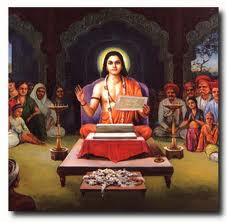
Shirdi Sai and Jnaneshwar - commentary on Bhagawad-Gita
Jnaneshwar, the well known Saint of Maharashtra was a gifted poet and a realized soul. At a very early age, he wrote Jnaneshwari (Dnyaneshwari) a commentary on the Gita in poetry form. In his Jnaneshwari, he calls the Gita the literary image of Lord Krishna (IX.2).
Sri Jnaneshwar, says that true knowledge consists in knowing God in the non-dual form and that devotion should culminate in Advaita (non-dual) bhakti. This shows Jnani-Bhakta (VII.17) He was born in a village Alandi about 20Kms from Pune in 1271. He is worshiped all over Maharashtra as Mauli (Mother) by a large number of devotees.
Sri Jnaneshwar, says that everyone should perform his duty as a Yajna and offer his or her actions as flowers at the feet of God. He took Sanjivan Samadhi when he was only 22 years old. (The Nirvikalpa or Sanjivan Samadhi is well explained by the greatest yogi, Dhnyaneshwar. In his treatise, Bhavarthadeepika or Dhnyaneshwari, Dhnyaneshwar has emphatically talked about relation between higher awareness and light or pure energy in the form of electromagnetic radiation).
All the accounts of his life have been written on the basis of three chapters in the Namdeva Gatha (collection of Abhangas), entitled Adi, Tirthavalli and Samadhi.
At one time it was accepted by all that the Philosophy of Sri Jnaneshwar was the same as that of Sri Shankara. They both were non-dualists. In the ninth chapter, Sri Jnaneshwar states, "The supreme Self is formless, without limiting conditions, inactive beyond the qualities, changeless, formless, all-pervasive, unmanifest and on-dual. But people ascribe form to the formless.
Just as the rays of the Sun are not different from the Sun, so there is unity between God and Universe. The devotion, which is offered to Him with the knowledge of his unity, is known as non-dual bhakti. When a person attains full knowledge as a sthitaprajna or a jnani-bhakta, he does not experience that the world is unreal. On the other hand, the sthitaprajna becomes one with the world after he renounces egoism and all sense objects (2.267). The Jnani-bhakta becomes free from the notion of dualism and experiences that he has become one with the universe (12.191)
Sri Jnaneshwar, holds that even if the world is real, the world appearance is not real.
Sri Jnaneshwar did not accept the doctrine that this world is the play of the Supreme (Chidvilasa) like Sri Ramanuja, who regards the visible world too as real, being the play of the Supreme Person.
The Shankara bhashya and Sri Jnaneshwar also differ in their view as to which Yoga is considered more important in the Bhagawad-Gita. Sri Shankara regards the Yoga of Knowledge as primary with both the Yoga of Action and the Yoga of Devotion as subsidiary and supportive of it. He says the seeker attains liberation in the following order - Purification of the mind through Karma Yoga, Renunciation through the way of Knowledge and self-realization.
In the opinion of Sri Jnaneshwar, all the methods of Yoga are equally valid and one has to adopt the Yoga according to his aptitude.